


Case study, last-mile logistics
Auto Vendi, an autonomous delivery robot
A delivery robot that takes an order from a phone app, drives itself through the building and brings a locked compartment to the person who ordered, who releases it from the app.
A hardware, B software, C AI
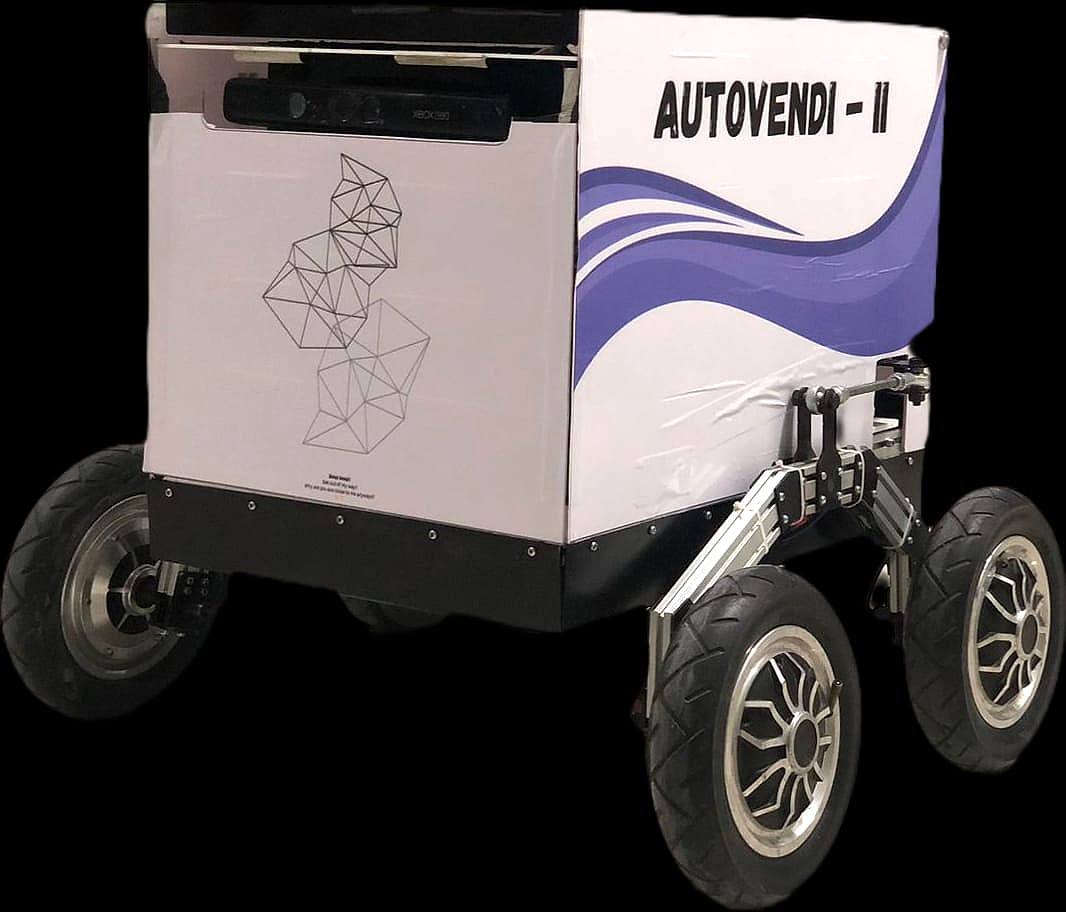
What is Auto Vendi?
Auto Vendi is an autonomous delivery robot designed and built by WhiteHat Design Studio. A delivery robot fails in the gaps. The robot can drive perfectly and still be useless if the app cannot tell it where to go, or if the compartment will not release for the right person. Auto Vendi joins three inputs in one prototype: A, the robot and its lock; B, the app that takes the order and releases the lock; C, the mapping and detection that get it there.
The full sequence is on film: an order on the phone, the robot crossing a lobby and a corridor, and at the end the lock released from the phone and the lid lifted by hand.
How Auto Vendi works.
Order
The person chooses what they want and where it should go, in a phone app.
Map and drive
Visual SLAM builds the map as the robot moves, and it plans its route and avoids obstacles as they appear.
See
YOLOv8 object detection runs alongside the mapping.
Hand over
The compartment stays locked on the way. When the robot arrives, the app releases the lock and the person lifts the lid.
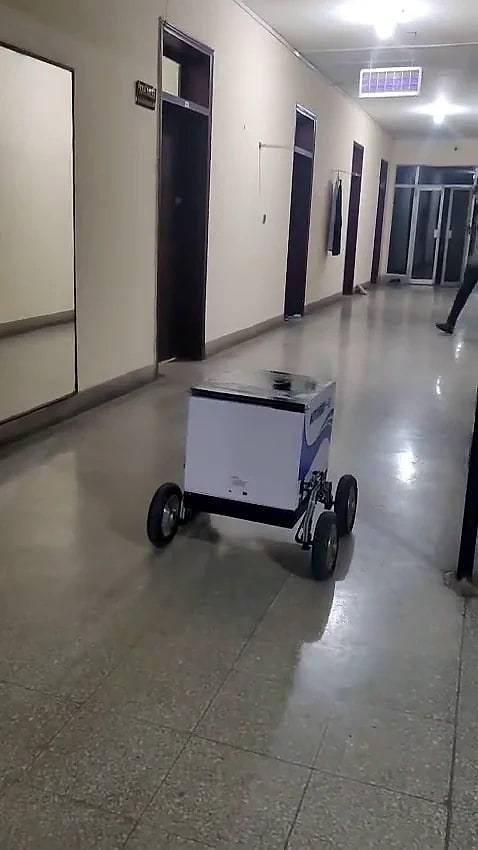
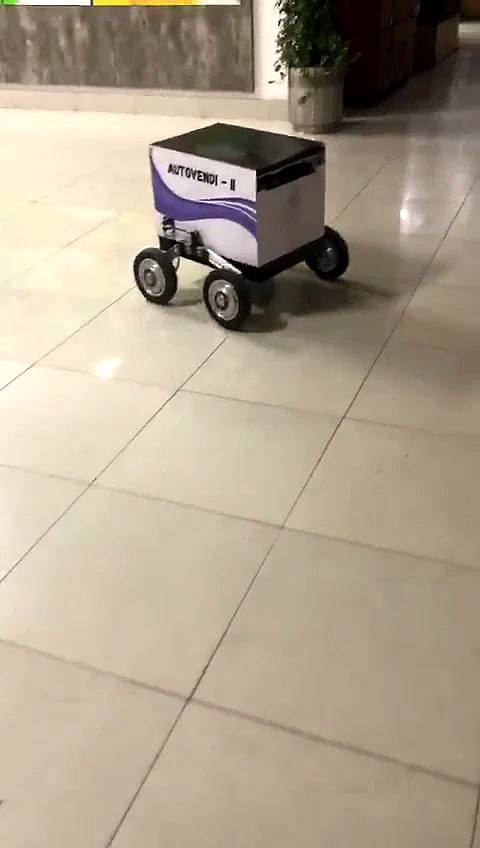
On film.
Clips from the log. They have no sound, and each one says what happens.
Questions about Auto Vendi
What is Auto Vendi?
Auto Vendi is an autonomous delivery robot designed and built by WhiteHat Design Studio. It takes an order from a phone app, drives itself through the building and brings a locked compartment to the person who ordered.
How does the person get their delivery?
The compartment stays locked on the way. When the robot arrives, the phone app releases the lock and the person lifts the lid.
Has Auto Vendi been tested outdoors?
Not in a published test. The published tests are indoors, in corridors and a lobby. The chassis is built for smooth and rough ground.
What we do not claim
- The published tests are indoors, in corridors and a lobby. The chassis is built for smooth and rough ground, but no outdoor test is published yet.
- No measured result is published yet.
Sources
Published , updated .
Read further
- Hardware: robotics and embedded systems design
- Software: dashboards, web apps and automation
- Mobile and web applications: mobile and web application development
- AI: computer vision and edge AI
- Visual SLAM vs LiDAR SLAM for indoor robots
- How to turn a prototype into a product
- Why a vision model that works in the lab fails in the field
Tell us what has to work.
One sentence is enough. An engineer will reply.