


Research prototype, assistive robotics
ReFlex, a prosthetic hand that chooses its grip
A research prototype of a prosthetic hand that starts moving on the wearer's muscle signal and uses a camera in the palm to choose the grip.
A hardware, C AI
What is ReFlex?
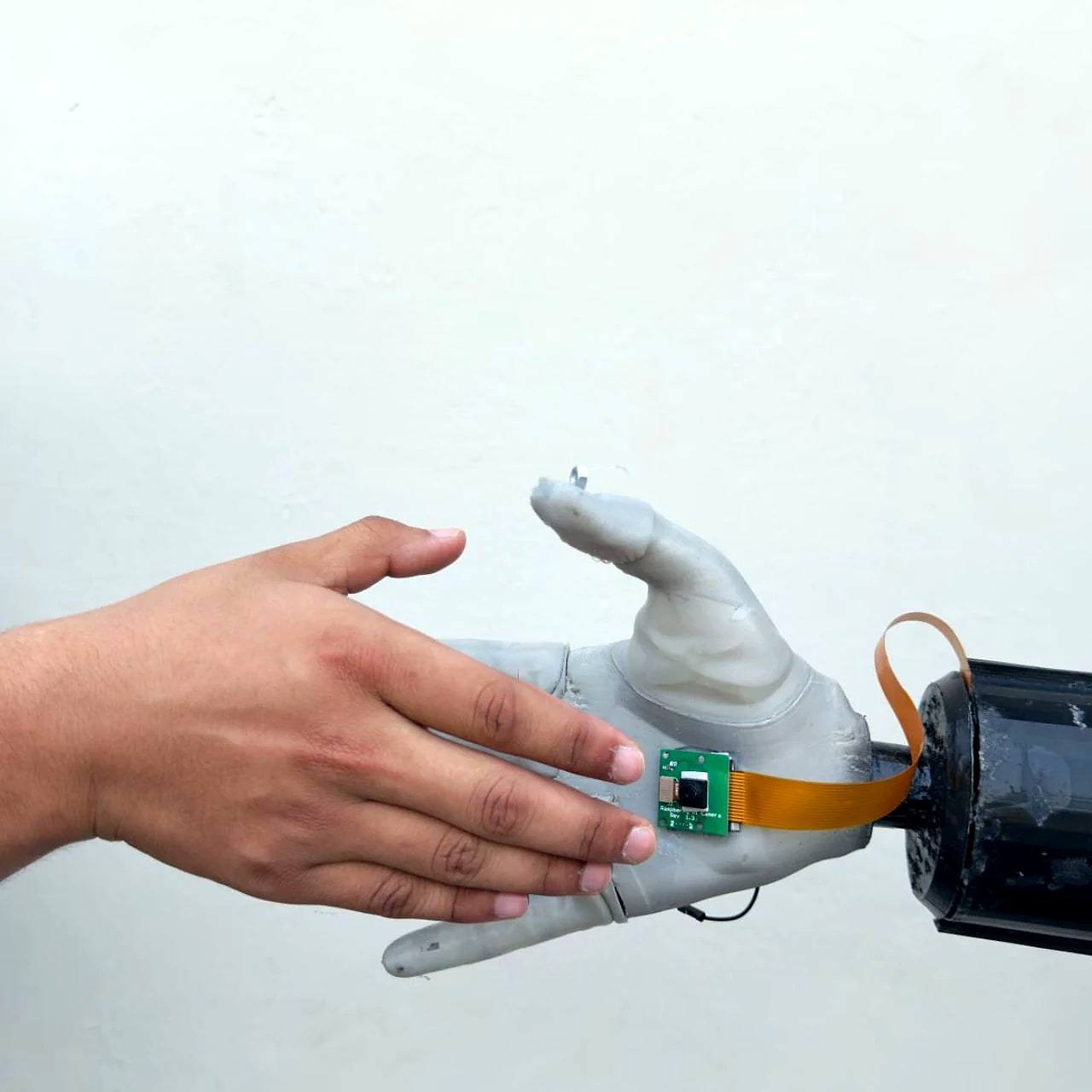
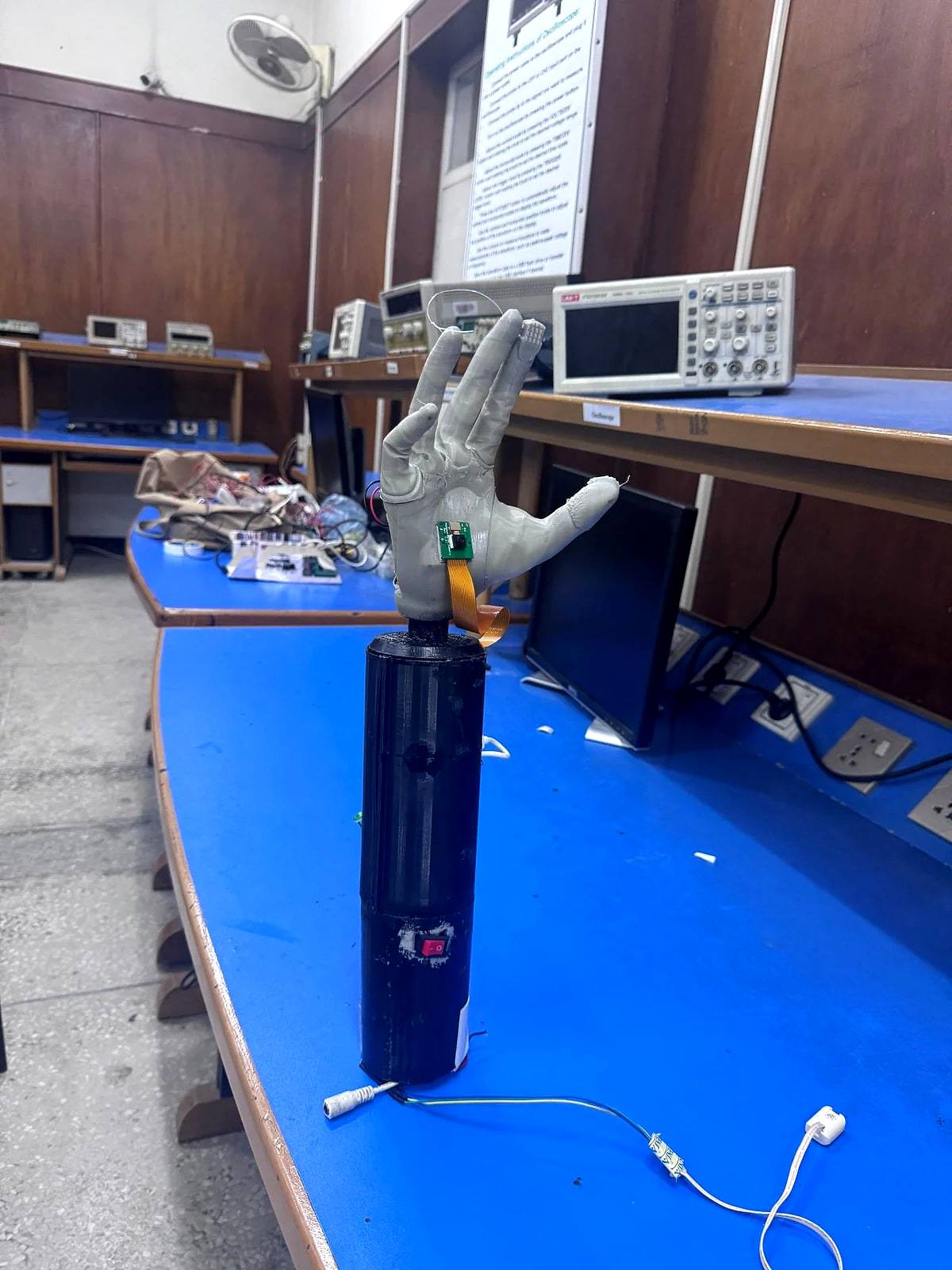
ReFlex is a research prototype of a prosthetic hand, designed and built by WhiteHat Design Studio. The hard part of a hand is not any one input. It is coordinating three: what the wearer intends, what the object in front of them is, and where each finger actually is. ReFlex connects the mechanical design, the electronics and the control software into one working loop on the bench.
The fingers are 3D-printed in TPU 95A, a flexible material, and pulled closed by strings, much as tendons close a hand. A custom sleeve holds the assembly on the forearm.
How ReFlex works.
Calibrate
At start-up the hand calibrates to the wearer's EMG signal and sets its threshold.
Sense intent
An EMG sensor reads forearm muscle activity. A moving average smooths it, and a change above the threshold starts a movement.
See the object
If the hand is open, the camera in the palm looks at the object. A custom-trained MobileNetV2 model, running through TensorFlow Lite on a Raspberry Pi 5, chooses the grip, such as pinch or tripod.
Close and stop
The motors for that grip drive the string-driven fingers closed, and each one stops when its encoder reaches its limit or the finger stalls.
Open
The next signal drives the motors back until the fingers reach their rest position.
Questions about ReFlex
What is ReFlex?
ReFlex is a research prototype of a prosthetic hand, designed and built by WhiteHat Design Studio. It starts moving on the wearer's muscle signal and uses a camera in the palm to choose the grip.
How does ReFlex choose a grip?
The camera in the palm looks at the object, and a custom-trained MobileNetV2 model, running through TensorFlow Lite on a Raspberry Pi 5, chooses a grip such as pinch or tripod.
Is ReFlex a medical device?
No. ReFlex is a laboratory research prototype. It is not a medical device.
Recognition
- Two conference papers at ICRAI 2024, on soft robotic fabrication with embedded vision and on a lightweight network for grasp classification.
- An appreciation award at COMPECC for the intelligent prosthetic hand.
What we do not claim
- ReFlex is a laboratory research prototype. It is not a medical device.
- Grip accuracy is not quoted here.
Tell us what has to work.
One sentence is enough. An engineer will reply.